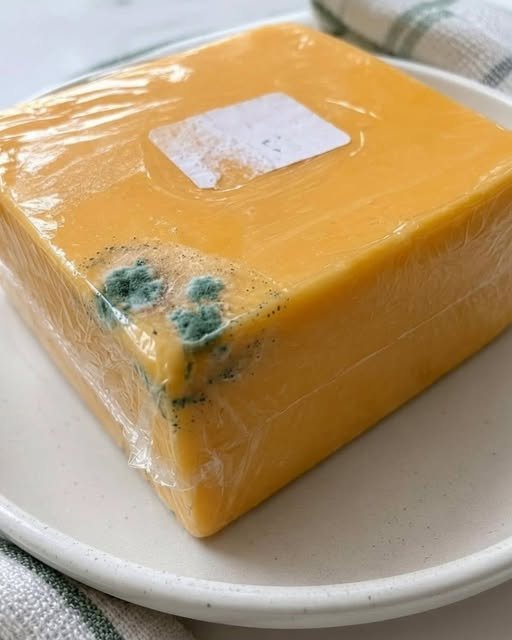
Finding green mold on a block of cheddar can be alarming. Should you cut away the moldy part, or is the entire block unsafe?
The answer depends largely on what type of cheese you have.
For a firm, hard cheese such as cheddar, USDA guidance says you generally do not have to throw away the entire block because of a small mold spot. Instead, you can cut away the mold and at least 1 inch (2.5 cm) around and below the affected area, keeping the knife away from the mold itself. (Ask USDA)
Can You Eat Cheddar After Removing the Mold?
If it is a hard block of cheddar and there is only a small, localized patch of mold, USDA guidance allows the remaining cheese to be kept after properly cutting away the affected portion. Afterward, wrap the cheese in fresh packaging and return it to the refrigerator. (Ask USDA)
The reason this differs from softer foods is that hard cheeses have a much lower moisture content, making it more difficult for mold to penetrate deeply compared with soft, moist foods. FDA classifies cheddar among hard cheeses with less than 39% moisture. (U.S. Food and Drug Administration)
How to Cut It Safely
Don’t simply scrape the green spot from the surface.
Instead:
- Use a clean knife.
- Cut at least 1 inch (2.5 cm) around the mold.
- Cut at least 1 inch below the affected area as well.
- Keep the knife from touching the mold while cutting.
- Remove the moldy section completely.
- Wrap the remaining cheese in fresh wrapping.
- Keep it refrigerated. (Ask USDA)
When Should You Throw Away the Entire Cheese?
The situation is different with soft cheeses. USDA recommends discarding soft cheeses when mold appears because mold can penetrate much more easily. (Ask USDA)
It’s also safer to discard cheddar if:
- Mold is widespread over the block.
- There are multiple large areas of mold.
- The cheese has an unusual smell or other signs of spoilage.
- The cheese is actually a soft or high-moisture cheese rather than a firm block.
- You aren’t sure what type of cheese you have.
FDA also advises consumers to be cautious with foods showing signs of spoilage. (U.S. Food and Drug Administration)
What About Shredded or Sliced Cheddar?
A block of firm cheddar is different from shredded or sliced cheese. Once cheese is cut into many small pieces, there is much more exposed surface area, making the simple “cut off 1 inch” rule inappropriate to apply automatically.
If mold is visible throughout shredded or sliced cheese, the safer choice is to discard it.
Don’t Just Scrape the Mold Off
One common mistake is to see a small green patch and simply scrape the surface before continuing to eat the cheese.
Mold can extend below the visible surface. USDA explains that what we see on food is only part of the mold growth, and deeper threads can penetrate into the food. (Ask USDA)
That’s why the recommended approach for hard cheddar is to cut deeply and generously around the affected area, rather than simply scraping it away.
What If It’s a Cheese Where Mold Is Supposed to Be There?
Some cheeses are intentionally made with edible molds, including cheeses such as Roquefort, Gorgonzola, Stilton, Camembert and Brie. The mold used as part of their normal production is different from unexpected green mold appearing on ordinary cheddar. (Ask USDA)
The Bottom Line
Small patch of green mold on a solid block of cheddar? You generally don’t need to throw away the entire block. According to USDA guidance, cut away at least 1 inch around and below the mold, keeping the knife away from the mold, then rewrap and refrigerate the remaining cheese. (Ask USDA)
Mold on soft cheese or widespread mold? Throw the cheese away.
And if you’re unsure, when in doubt, throw it out. Food safety is more important than saving a few slices of cheese.